
4 min read
Introduction: Bringing Ideas to Life in 3D
The future of creation isn’t just flat.
It’s three-dimensional, intelligent, and instant.
As AI reshapes industries from art to architecture, Tencent’s Hunyuan3D 2.0 steps forward — offering a revolutionary platform that turns text prompts into high-fidelity, realistic 3D models in minutes.
Hunyuan3D 2.0 isn’t just building models. It’s building the future of interactive design.
Let’s dive into how this new AI model is transforming the world of 3D generation.
⸻
What is Hunyuan3D 2.0?
Hunyuan3D 2.0 is Tencent’s latest AI-powered system designed to generate detailed 3D objects directly from natural language descriptions.
Unlike traditional 3D modeling, which requires intensive manual design, complex software skills, and hours (or days) of work —
Hunyuan3D allows anyone to create realistic 3D structures through simple, intuitive prompts.
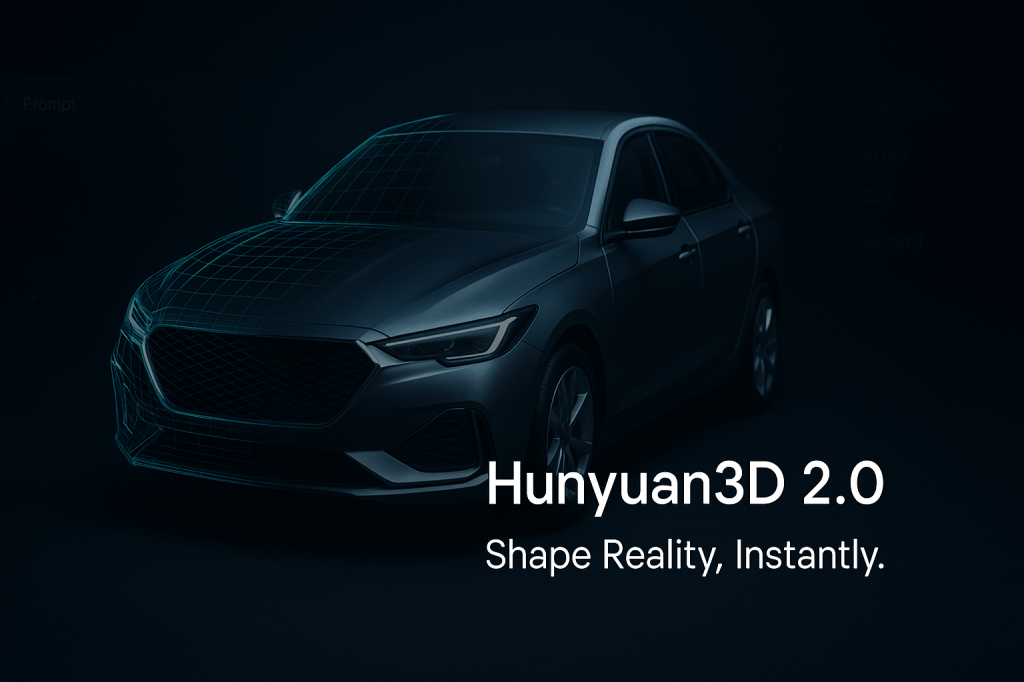
From characters to products to architectural prototypes, Hunyuan3D 2.0 can produce full mesh models complete with texturing, shading, and physical realism — drastically reducing the time and barrier to 3D creation.
⸻
Key Features of Hunyuan3D 2.0
1. Text-to-3D Generation
Turn simple text prompts into complex 3D shapes — fully rendered and ready for use across industries.
⸻
2. High-Fidelity Mesh Outputs
Models are not just basic wireframes. They feature dense, clean mesh structures with intricate surface details — making them suitable for animation, VR, games, and digital twins.
⸻
3. Realistic Textures and Materials
Hunyuan3D automatically applies physically-based rendering (PBR) materials, giving models realistic reflections, surface imperfections, and dynamic lighting responses.
⸻
4. Multi-Angle Consistency
Unlike many earlier AI systems, Hunyuan3D ensures that objects look coherent from all angles — critical for 3D usability in games, AR/VR, and simulations.
⸻
5. Scalable Production
Designed to generate not just one-off models but large batches of 3D assets for studios, game developers, architects, and e-commerce brands.
⸻
6. Fine Control Over Style and Structure
Users can specify parameters like:
• Object scale
• Style (realistic, stylized, cartoonish)
• Texture richness
• Material types (metallic, organic, synthetic)
⸻
Real-World Use Cases for Hunyuan3D 2.0
• Game Development:
Rapidly generate props, characters, and environments with detailed textures and ready-to-rig meshes.
• E-commerce and Retail:
Create product visualizations and interactive 3D displays for websites without expensive photoshoots.
• Architecture and Urban Design:
Prototype structures, interiors, and city layouts from concept descriptions.
• VR and AR Applications:
Build immersive, realistic environments and assets for next-gen experiences.
• Industrial Design:
Mockup product designs, machinery, and simulations with minimal turnaround time.
⸻
How Hunyuan3D 2.0 Stands Apart
Most previous text-to-3D models struggled with:
• Coherence from multiple angles
• Texture realism
• Mesh cleanliness for real-world use
Hunyuan3D 2.0 aggressively tackles all these issues, delivering models that are ready for production, not just visual demos.
Tencent’s integration of deep diffusion models, geometric consistency engines, and advanced material understanding allows Hunyuan3D to lead the race toward practical AI-driven 3D creation — not just art showcase generation.
⸻
Conclusion: Hunyuan3D 2.0 and the New Dimension of AI Creativity
Hunyuan3D 2.0 signals a deeper shift —
where imagination isn’t just written or drawn anymore — it’s sculpted into reality.
As AI erases traditional technical barriers,
the world of 3D creation becomes more accessible, democratic, and exponentially faster.
The question is no longer “Can you build it?”
It’s “Can you describe it?”
And with Hunyuan3D 2.0, the answer can arrive in minutes.
⸻
FAQs about Hunyuan3D 2.0
1. Is Hunyuan3D 2.0 available to the public?
Currently, Hunyuan3D 2.0 is being rolled out for select partners, with broader access expected in upcoming phases.
⸻
2. What file formats are supported for exports?
Models can typically be exported as standard formats like OBJ, FBX, or GLB for maximum compatibility.
⸻
3. Can users modify generated models?
Yes, models generated can be imported into traditional 3D software for further refinement, rigging, or animation.
⸻
4. Does Hunyuan3D 2.0 require coding or 3D design experience?
No — it is built for intuitive use through natural language prompts, lowering the barrier for non-technical creators.
⸻
5. Is the texturing customizable?
Users can influence style and texture density through prompt parameters or manually adjust textures after export.
⸻
6. How fast is model generation?
Generation typically takes a few minutes per model, depending on complexity and requested fidelity.
⸻
7. What industries can benefit most from Hunyuan3D 2.0?
Gaming, VR/AR, digital marketing, industrial design, education, e-commerce, and virtual production.

 The Artificial
Leave a comment