
Reading Time: 9 min read
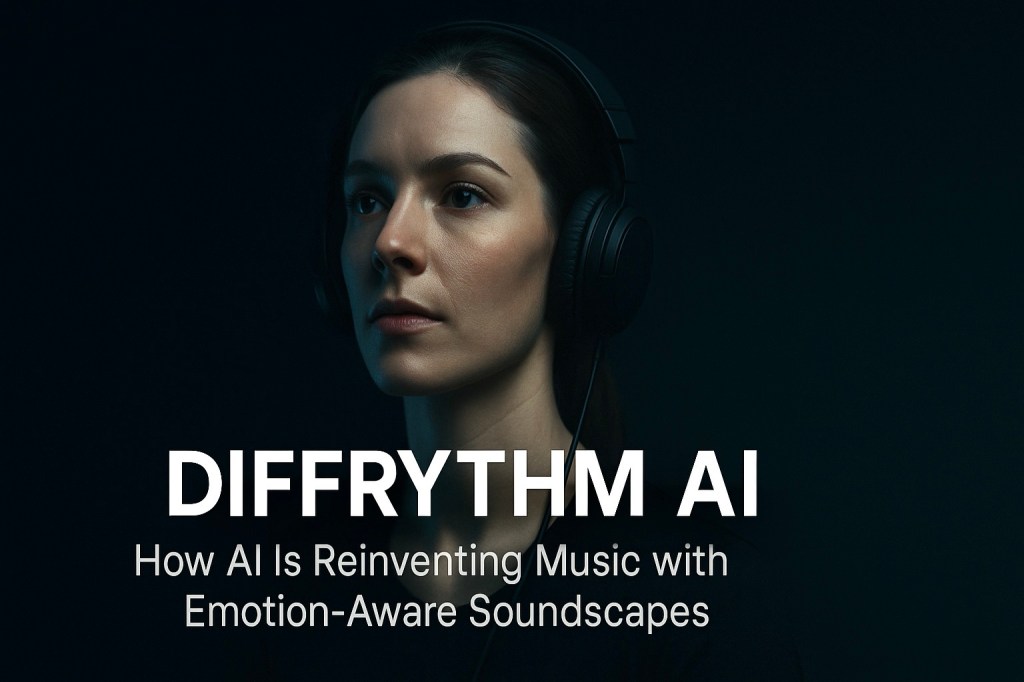
Music That Thinks, Feels, and Flows
Music has always had one goal — to make you feel. But what if music could start with feeling?
Enter Diffrythm AI, a generative audio engine that doesn’t just compose background tracks — it listens, reads, and feels. Whether you’re creating films, immersive games, or AI-generated stories, this tool reacts to emotional cues in real-time and generates soundscapes that evolve with your scene. Think of it as a musical co-creator that scores your world as it unfolds.
No loops. No static tracks. Just emotionally intelligent music — born from data, guided by mood, and rendered by AI.
What is Diffrythm AI?
Diffrythm is an advanced AI platform for dynamic music generation. It goes beyond static beatmakers and royalty-free loops by offering a real-time engine that understands emotional tone and adapts sound accordingly.
The tool uses multimodal learning to read emotional signals from:
Text (e.g., script excerpts, prompts) Video (scene analysis) Audio (voice tone or narration) Manual input (emotion sliders, genre guides)
It creates fluid, unique compositions that match the evolving vibe of your content. Whether your character is falling in love, sprinting through a battlefield, or reflecting in silence — Diffrythm adjusts every beat, chord, and melody to mirror that moment.
What Makes Diffrythm Stand Out?
1. Emotion Recognition in Music
Most AI music tools operate like puzzle-solvers. You give them a theme, they stitch together pre-built blocks. Diffrythm doesn’t work like that.
It analyzes emotional inputs — tone of voice, tension in a video scene, or sentiment in a script — and builds music that feels emotionally aligned. It composes like a human composer reacting to a movie scene in real time.
2. Live Adaptive Soundscapes
Once music begins, it doesn’t stop or repeat. Diffrythm’s engine continuously evolves the composition in response to inputs. That means if the mood shifts mid-scene, so does the music. No manual editing. No sudden transitions. Just one seamless emotional arc.
3. Royalty-Free, Original Audio
Everything composed by Diffrythm is:
100% unique Non-repetitive Royalty-free Downloadable in MP3, WAV, or multitrack stems
So, whether you’re publishing on YouTube, embedding into a game, or using it in a client project — you’re covered.
4. Genre-Fluid & Creator-Friendly
It doesn’t lock you into genres. You can blend:
Cinematic + Ambient Orchestral + Synth Lo-fi + Jazz Darkwave + Classical
…all within the same piece. You guide the feel — Diffrythm handles the complexity.
How It Works: Inside the Diffrythm Engine
Input Capture Upload a video, voice sample, script snippet, or scene summary. Or use real-time streaming inputs for live adjustments. Emotion Mapping The AI parses your input using multimodal transformers — detecting mood shifts, intensity, pacing, and emotional nuance. Sonic Generation Based on the emotional map, it selects instruments, tempos, keys, and transitions — crafting a piece from scratch. Live Playback & Adjustment Preview the sound as it adapts. You can tweak the emotion slider or nudge genres in real time. Export Options Export full mixes, loopable stems, or layer-by-layer instruments for advanced editing.
Real-World Use Cases of Diffrythm AI
1. Filmmakers & Indie Studios
Filmmakers often struggle with finding the right royalty-free music that matches a scene’s tension or vibe. Diffrythm allows them to auto-score entire short films — with scene-specific transitions and mood control.
2. Game Developers
Gaming is interactive. Players change pace, action, and emotions constantly. Diffrythm can dynamically adjust music to gameplay — intensifying battle themes, calming exploration music, or eerie tones when a player enters a haunted space.
3. AI Content Creators & Virtual Storytellers
Creators using AI tools like Sora, Gen-2, or D-ID to make short films or talking avatars can use Diffrythm to add emotional sound that changes with each generated scene. It gives life to otherwise static narration.
4. Wellness & Meditation Apps
Mental health and focus apps are using Diffrythm to generate calming, mood-responsive music. For example, a journaling app might analyze a user’s written reflections and play soothing or uplifting tones accordingly.
5. Podcasters & Voice Artists
Podcasters can add subtle musical transitions that follow the emotional arc of a conversation — laughter, tension, vulnerability. Diffrythm listens and responds in real time, making your podcast feel like a scored documentary.
6. Interactive Exhibits & Museums
Installations can use Diffrythm to react to visitor actions, voice comments, or motion sensors — turning static exhibits into living, sonic environments.
Why Diffrythm is the Future of Sound
In a world where video generation is getting easier by the day, sound remains a missing layer of realism. Static music doesn’t serve modern content anymore — creators need sound that breathes and moves.
Here’s why Diffrythm isn’t just another tool — it’s a shift:
Emotion = First-Class Citizen It puts emotion before structure. That’s how humans compose. Now AI does too. Frictionless for Creators No music degree needed. If you can describe a mood, you can generate a score. Syncs With Other AI Tools Works great alongside image and video tools — whether you use Pika, Runway, or Genmo. Zero Licensing Stress Stop worrying about rights or copyright strikes — Diffrythm’s music is yours. Realtime = Real Emotion The key isn’t just music. It’s timing. Diffrythm’s live rendering captures the when and not just the what of a moment.
Final Thoughts: Composing Without Composers
AI has written text, painted pictures, and generated video. But music? That’s been trickier. Because music is emotion made audible.
Diffrythm cracks that code. Not by mimicking top-charted songs or spitting out generic background tracks — but by listening, adapting, and feeling.
So whether you’re a solo creator, studio team, or just experimenting with AI storytelling, one thing’s for sure:
The future of sound won’t be silent. It’ll be Diffrythmic.
FAQs
What platforms can I use Diffrythm with?
You can use it as a standalone tool, or integrate it with video editors, game engines, and web apps via API.
Is it free to use?
Most features are freemium — free with some limits. Advanced real-time generation and stem exports may be paid.
Can I request a specific instrument or mood manually?
Yes. The dashboard allows you to adjust genres, instruments, emotion sliders, and pacing.
Does it work with mobile apps?
A web-based mobile version is available, though performance is best on desktop.
What file formats are supported?
MP3, WAV, and individual audio stems for editing or DAW integration.
How accurate is the emotion detection?
It uses high-quality training on emotional datasets from voice, video, and text. While not perfect, it’s consistently impressive.
Can I use Diffrythm in commercial projects?
Yes — all music generated is royalty-free and safe for monetized use.

 The Artificial
Leave a comment