
~45 min read
We all suffer from “Tab Fatigue.” It usually starts innocently enough: you search for something specific, like “best hiking boots for wide feet,” and ten minutes later, your browser is groaning under the weight of 15 open tabs.
You are staring at three SEO-spam review sites that all recommend the same Amazon affiliate links. You have a chaotic Reddit thread from 2022 where users are arguing about durability. You have an Amazon product page open, trying to decipher if the 5-star reviews are bots. You have a YouTube video loading in another tab that you’re desperately scrubbing through to find the actual wear-test segment. And finally, you have a paywalled article from Consumer Reports that you can’t even read.
You are drowning in data, yet starving for wisdom. The cognitive burden of synthesis—of connecting the dots between “comfortable,” “durable,” “in stock,” and “within budget”—falls entirely on you. You have to be the editor, the fact-checker, and the aggregator.
Google gives you links (and increasingly, ads). Perplexity gives you concise answers, which is an improvement. But sometimes, a paragraph isn’t enough. You need a deep dive. You need a synthesis of those 15 tabs without actually opening them. You need a structured, comprehensive report, not just a reply.
Enter Genspark.ai.
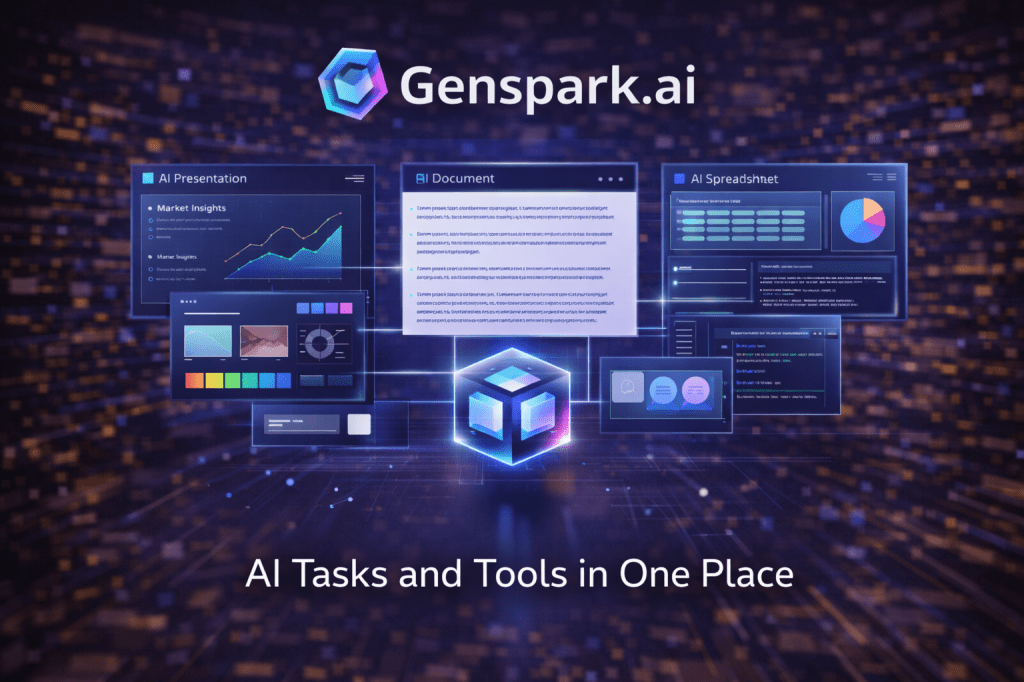
Genspark is not just another chatbot wrapper; it is the world’s first “AI Agentic Engine.” It represents a fundamental shift in how we retrieve information. It moves beyond the simple chat interface to build custom, single-page websites (called Sparkpages) for every unique query. It uses a swarm of autonomous agents to read the live web, cross-check facts, verify reviews across multiple platforms, and present a consolidated, bias-neutral report.
It feels less like a search result and more like a Wikipedia page written just for you, right now, by a team of tireless researchers who read the entire internet in seconds.
In this deep-dive guide, we’ll explore how Genspark is rewriting the rules of SEO, why “Agentic Search” is the only viable cure for the information overload crisis, and how its new “Super Agent” capabilities allow it to do far more than just search—it allows it to act.
What is Genspark.ai?
Genspark is an AI platform that generates “Sparkpages”—dynamic, one-page summaries—for any query, while offering a suite of autonomous tools for content creation and real-world action.
While ChatGPT is a generalist chatbot and Google is a directory of links, Genspark acts like a specialized, multi-disciplinary research team. It doesn’t rely on a single AI model; it orchestrates a “Mixture of Agents” architecture. It intelligently routes different parts of your request to top-tier models like GPT-5, Claude 3.5/3.7, and Gemini 1.5 Pro, depending on which model is best suited for the task (e.g., using Claude for nuance and Gemini for data extraction).
The Workflow: From Query to Sparkpage
To understand the power of Genspark, let’s trace the lifecycle of a single search to see how the “sausage is made”:
- Input: You type a complex, multi-faceted query that would normally break a standard search engine: “Plan a 3-day itinerary for Tokyo for a foodie who loves ramen, specifically focusing on hidden gems in neighborhoods like Shimokitazawa and Koenji, avoiding major tourist traps like Ichiran, and include travel times.”
- Process (The Autopilot Swarm): Genspark’s “Super Agent” analyzes the intent. It doesn’t just predict the next word; it treats this as a project management task. It breaks the prompt down into sub-projects and assigns them to specialized agents:
- The Cartographer: One agent connects to Google Maps API to scan for highly-rated ramen shops in the specified neighborhoods. It filters by rating count to avoid “tourist traps” (places with 10k+ reviews) and looks for high scores with fewer reviews (local gems).
- The Critic: Another agent reads travel blogs, Substack newsletters, and Reddit threads (
r/JapanTravel,r/Ramen) to verify the “hidden gem” status. It cross-references “tourist trap” warnings to ensure the chosen spots aren’t hype-driven. - The Scheduler: A third agent checks opening hours (Japan has notoriously complex split-shift hours), cross-references them with your 3-day timeline, and optimizes the route to minimize travel time between stops.
- Output: Instead of a wall of text, it generates a Sparkpage. This is a rich, interactive UI that functions as a standalone website:
- Structured Itinerary: A visually distinct day-by-day plan with time blocks, showing you exactly where to be and when.
- Interactive Maps: Embedded maps showing the ramen shops relative to train stations, allowing you to visualize the route.
- Review Aggregation: A “Pros and Cons” section for each location based on aggregated user reviews from multiple platforms (Tabelog, Google, TripAdvisor), summarizing the consensus rather than making you read 50 individual comments.
- Visual Proof: Embedded videos from TikTok/YouTube showing the actual food inside the restaurant, so you can vibe-check the atmosphere before you go.
It condenses the “20-tab browsing session” into one scrollable view that acts as the end of your search journey, not the beginning.
Key Features: Beyond Search
Genspark has evolved from a search engine into a comprehensive Knowledge Workspace. Here are the standout features that differentiate it from competitors like Perplexity and Google Gemini.
1. The Sparkpage (Your Custom Wikipedia)
This is the core differentiator. Every search generates a persistent, shareable URL. You aren’t just getting an ephemeral answer; you are creating an asset.
- Editability: You have editorial control. If the AI suggests a restaurant you hate or have already visited, you can delete that section or ask the AI to “swap this for a sushi place.” The page rebuilds instantly around your feedback.
- Shareability: You can search for “Comparison of iPhone 16 vs Pixel 9 Pro” and send the resulting Sparkpage to your friend via WhatsApp or Slack. They see the full comparison table, video reviews, and spec sheets without needing to run the search themselves. It becomes a shared source of truth.
2. “Call for Me” Agent (Action in the Real World)
Genspark isn’t just for reading; it’s for doing. The Call for Me agent bridges the gap between the digital and physical world, effectively acting as an automated secretary.
- The Scenario: You find a perfect restaurant on your Sparkpage for Saturday night, but their online booking system is down or nonexistent.
- The Action: You click “Call to check availability.”
- The Agent: It autonomously dials the restaurant. It navigates the phone tree (“Press 2 for reservations”). It speaks to the host using a natural, neural voice. It asks for a table for two at 7 PM. If that time isn’t available, it asks for the nearest available slot.
- The Result: It returns a transcript and summary of the call to you: “I spoke to Mark. They are full at 7 PM, but have an opening at 8:15 PM. Should I call back to book it?”
3. AI Slides & Content Creation
Genspark includes dedicated agents for creating professional deliverables, turning research into output instantly. This destroys the “Blank Page Problem.”
- AI Slides: Turn a Sparkpage or a topic into a fully formatted PowerPoint/Google Slides presentation deck in seconds. It writes the bullet points, selects the layout, finds relevant high-res images, and structures the narrative flow.
- AI Sheets: Analyze data tables found in search results (e.g., stock performance, population demographics) and generate downloadable spreadsheets with charts and pivot tables ready for analysis.
- AI Docs: Draft long-form content (blog posts, white papers, essays) based on the research it just performed, citing its sources automatically. This ensures your writing is grounded in fact, not hallucination.
4. Multi-Perspective Analysis (Bias Neutrality)
Search engines often create echo chambers based on your browsing history. Genspark fights this with “Parallel Search.” If you search for a controversial topic or a polarizing product, Genspark explicitly structures the page to show “Viewpoint A” vs. “Viewpoint B,” or “What Critics Say” vs. “What Users Say.”
- Example: Searching for “Is the new Tesla Cybercab safe?” will yield a section on “Regulatory Claims” (Official Data) next to “User Concerns” (Reddit/Forum anecdotes). This side-by-side presentation gives you a holistic view of the truth rather than forcing you into a single SEO-optimized narrative.
Pricing: Free vs. Pro
Genspark operates on a freemium model that is surprisingly generous, designed to get users hooked on the “Sparkpage” format before asking for a credit card.
- Free Plan: Perfect for testing and casual daily use. You get roughly 100-200 daily credits, which covers basic research and standard Sparkpages. You get access to the core agents but with rate limits on premium models (like o1 or Claude Opus). It’s robust enough to replace Google for most users.
- Plus Plan (~$25/month): The sweet spot for professionals, students, and content creators. This unlocks roughly 12,000 monthly credits and gives you access to premium “Reasoning” models (like OpenAI’s o3-Pro and Claude 3.7) which are better at complex logic tasks. It also allows you to create more AI Slides and extensive research reports without throttling.
- Pro Plan (~$250/month): For power users, researchers, and enterprise teams. This offers a massive credit allowance (125k+), priority queueing for agents (skipping the wait times during peak hours), and unlocked access to high-cost features like “Call for Me” (telephony costs) and extensive video generation.
Real-World Use Cases
1. The Complex Purchase (Filtering SEO Spam)
- Query: “Best ergonomic office chair under $500 for tall people (6’2″+).”
- The Problem: Google gives you “Top 10 Chairs” lists from affiliate spam sites that don’t actually test the chairs, just scrape Amazon specs.
- Genspark Result: It builds a comparison table of 5 chairs. Crucially, it specifically highlights the “Maximum Height” and “Seat Depth” specs (which are usually hidden deep in PDF manuals). It includes a summary of Reddit comments regarding durability for heavy users, filtering out the “paid” or “incentivized” reviews on Amazon.
2. The Hyper-Specific Travel Plan
- Query: “Weekend trip to Napa Valley, must be dog friendly, avoiding crowds, budget under $400/night.”
- Genspark Result: A tailored itinerary that intelligently filters out the most famous (and crowded) wineries. It highlights obscure, family-run vineyards with dog-friendly patios. It includes a map layer showing which hotels accept pets without a massive cleaning fee. It even checks the weather forecast for that specific weekend to ensure outdoor seating is a viable option.
3. The Executive Briefing (Market Research)
- Query: “State of the EV market in Southeast Asia 2025, focusing on Chinese competitors vs. Tesla.”
- Genspark Result: A comprehensive report (“Sparkpage”) summarizing government subsidies in Thailand and Indonesia, top-selling models by unit volume, and infrastructure challenges. The user then clicks “Generate Slides” to turn this text report into a 10-slide deck for a Monday morning meeting, complete with citations, saving hours of manual formatting.
4. The Daily Admin (Phone Agent)
- Query: “Find a plumber in Seattle who can come today to fix a leak.”
- Genspark Result: It finds 5 highly-rated plumbers in the local area. The user selects “Call for Me” on the top 3 results. The agent calls them in parallel to ask about availability and emergency rates. It returns a summary: “Plumber A is booked. Plumber B can come at 2 PM for $150 dispatch fee. Plumber C didn’t answer.” This turns a stressful hour of phone tag into a single click.
Genspark vs. Perplexity vs. Google
| Feature | Genspark.ai | Perplexity | Google Search |
| Output Format | Sparkpage (Rich UI/Webpage) | Concise Answer + Sources | List of Links + Ads |
| Agentic Capability | High (Calls, Slides, Cross-checking) | Medium (Search & Summarize) | Low (Retriever) |
| Depth | Deep Dive (Multi-agent verification) | Quick Answer | Index |
| Speed | Slower (Builds a page ~10-20s) | Fast (~2-5s) | Instant (<1s) |
| Bias Handling | High (Explicitly shows viewpoints) | Medium | Low (Algorithmic) |
| Best For | Complex Research / Deliverables | Quick Answers / Fact Checking | Navigational Search |
Limitations and Trade-offs
- Latency: Building a high-quality Sparkpage takes time. It’s not instant like a Google search. You might wait 10-20 seconds for the agents to read, synthesize, and assemble the full report. It requires a mindset shift: you are trading speed of search for speed of understanding.
- Information Density: Sometimes a Sparkpage can be too long. If you just wanted to know “What is the capital of France?”, Genspark is overkill. It’s a tool for depth, not trivia.
- Credit Management: The “Call for Me” and Video features act as “credit sinks.” Users on the lower tiers need to be mindful of their usage, as complex agentic tasks burn credits faster than simple text searches.
- Hallucination Risk: While the “cross-checking” agents reduce this significantly, any AI tool synthesizing data can misinterpret a nuance, especially in highly technical or medical fields. Always verify the citations provided before making critical decisions.
Conclusion
Genspark is search for people who want to “know,” not just “find.”
It moves us away from the era of being a “Search Engine Operator”—a human middleware whose job is to click links, close pop-ups, and filter spam—to being a “Research Director”. Your job is to define the goal, and the AI’s job is to execute the research and present the report.
Whether you are planning a complex trip, buying a high-stakes product, or preparing a business presentation, Genspark turns the chaotic internet into a structured database that works for you. It reclaims the time you used to spend tab-switching and gives it back to you as insight.
Ready to stop tab-switching?
Go to genspark.ai, try a query that would usually take you 20 minutes (e.g., “Compare the 3 best CRM tools for a team of 5 freelancers”), and watch it turn into a website in 20 seconds.
 The Artificial
Leave a comment